What teenagers can teach us about sincerity and gift-giving
The second unit of my Creative Writing class, the one that brings us to winter break, is poetry. For eight weeks, we read and write poems, exploring different forms – pantoum is always a favorite, as is the cento; the villanelle, with its rhyme scheme and braided repetition, is often abandoned. Half my students really take to these poetic containers and, in fact, find more creativity within the parameters of a certain restraint. The other half resists and just wants to write whatever they want. I’d always planned for the last poem to be something of their choice. Last year, I came up with the idea of having students write Secret Santa poems to each other, which we would open up on the last day of class before the holiday. They could write in whatever form they wished, it just had to either be about the person or for them, in some way.
I wrote our names on slips of paper – including mine – and we drew our subject out of a bowl. One student suggested putting together a questionnaire for the entire class to fill out, so that they could get to know each other a little better. They knew each other through their writing, but there were tidbits of information – like their favorite color, favorite snack, or where they felt happiest (questions my students included in the questionnaire) – that they weren’t privy to. We could see each other’s answers on a spreadsheet. I made a mental note that filling out questionnaires students had put together themselves was a low-stakes way for them to feel connected, for them to have an easy way to begin conversations.
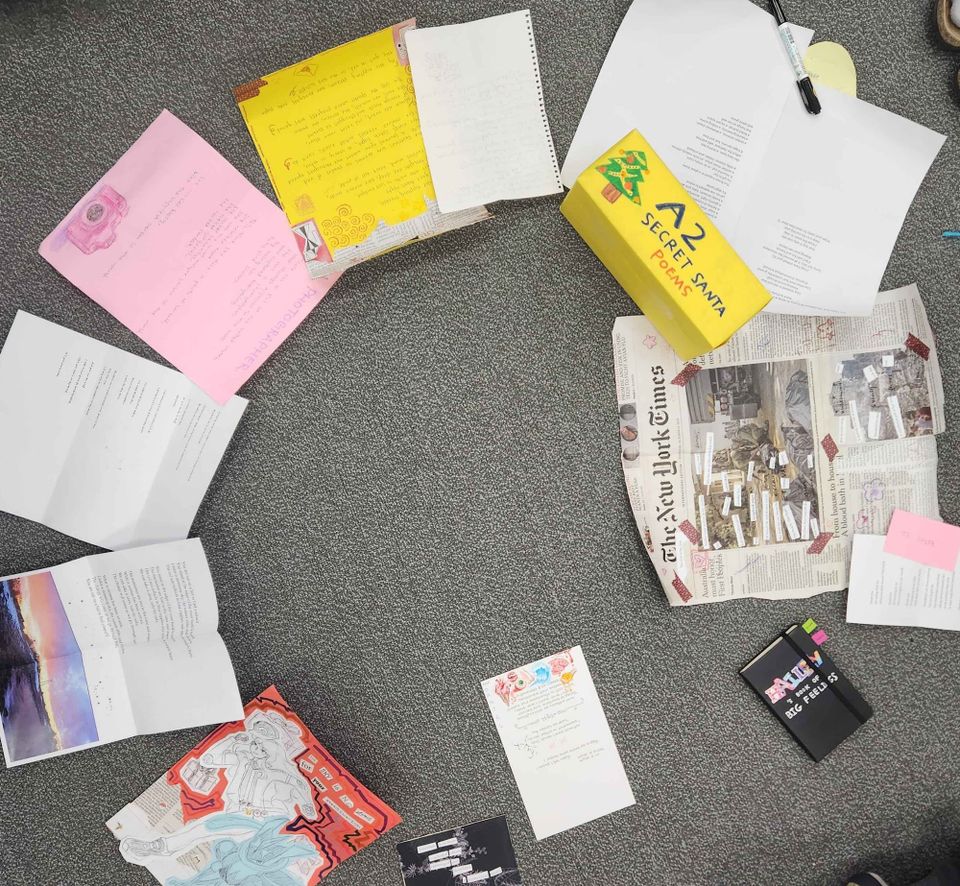
I refashioned an old tissue box into a holiday-themed mailbox and asked the students to drop their poems into the box before our last class, which would be in two weeks. I got to work right away, taking a personal essay that my Secret Santee student had written in our first unit and scissoring it into phrases and words, creating a cut-up, Burroughs-style poem out of her words. For the first week, mine was the only poem in the mailbox and I worried this idea would fizzle out.
But a few days later, poems started showing up in the mailbox. Some were simple print-outs, some were collages, there were also a few illustrated poems. My student, C, approached me a day before our last class and admitted, “I’m going all out.” She looked simultaneously sheepish and excited. The next day, she showed me a pocket-sized journal, the cover of which she’d decorated with cut-out letters: H’s Big Book of Feelings. There were two tabs sticking out, one for the poem C had written for H and one for an index of emotions.
On the day of the party, there were a few stragglers who needed my help printing; I helped them hold their poetic scrolls together as they tied a piece of yarn around it. I noticed that their fine motor skills were blunted – do these Crocs/Uggs wearing kids even tie laces anymore? Suddenly, I became nervous about the quality of these procrastinated poems and admonished myself for not being more vigilant about their progress, or being deliberate about curating the Secret Santa/Santee pairing.
The students decided as a group that they would open up their poems at the same time, so that they could save each other the awkwardness/pressure of seeing each other’s facial expressions. I handed out all the poems and it felt like Christmas morning, the anticipation was so genuine and pure, I could tell that no matter what they unveiled, everyone already loved what they were holding in their hands.
I told everyone to open their poems, as I unfolded mine. It was a palindrome poem that could be read forwards and backwards, one of the forms we had studied and written just weeks prior. The poem described a person sitting by the window, an orange sun dipping below the horizon outside, cleaning her small reading glasses as she begins to write. The poem was about me. Towards the end of the poem, this imperative from my student: rest today, work tomorrow, which felt, after an especially busy first semester of teaching, deeply comforting.
When I looked up from my poem, I saw that one student had tears streaming down her face. H, the recipient of the mini journal, had serendipitously been paired up with C, who had made the journal, and they were hugging. “This is the best gift!” I heard someone say. “Can we read them out loud?” someone else pleaded.
One of my more vocal students – a star debater with a penchant for wordplay – wrote about one of my most quiet students –
You sit still and quietly but now
I have noticed and will now commend the quick-start fighter inside,
The one who sees all the prison bars society has built and is jumping to break them down,
The one who will fight the world to prove that mint ice cream doesn’t have to taste like toothpaste.
Mint-ice-cream-crusader looked up from her poem and said to poetic debater, quietly, but without irony or embarrassment, “I love you.”
The day before the party, as a student was dropping her poem into the mailbox, she said to me, “The thing is, it’s really hard not to sound romantic.”
After a brief disclaimer at the start of her poem, she concluded –
What I mean is it feels like everything around me is waiting to be shaken up.
A calmness just about to go up in flurries.
Like the moment right after you sneeze or finally understand something itching at the corners of your brain.
It’s nice.
I know that I don’t know you well.
But I know how your writing feels.
I think maybe that’s enough.
Perhaps what my students mistake for romance is merely sincerity. In this age of one-line quips, texts, AI memes and the fear of being awkward and cringey, it’s easy to mis-read honesty for romance. Teenagers don’t often get the opportunity or space to tell each other what they see and appreciate about each other and admittedly, this wasn’t really my intention for our last poetry assignment, but it is what happened because the students made it so. They proved to each other that it is so much better being real and honest than it is to be cool.