The wild & gentle female energy of horses
I was never a horse girl. I did not relate, when, in the 1980s, most young girls seemed to go through a horse phase. I remember visiting my cousin in California and seeing all of her Black Stallion paperback books and plastic horse figurines in different poses and colors with manes made of Barbie hair that you could brush with a tiny comb. I found the equine adoration intriguing, but ultimately, it did not interest me. My best friend lived for some years in the California desert and said she used to have her own horse, which felt utterly alien to someone like me, who had grown up in the middle of a bustling city. She might as well have said she had her own airplane, the idea of owning such a large animal completely wild and inconceivable. When my kids were little, one of the first cartoons all three of them could watch and enjoy together was My Little Pony: Friendship is Magic. This was a series based on the 1980s Hasbro toys, which was marketed to young girls.
What is it about girls and horses?
*
A few weeks ago, my husband asked me if there was one book I should have read, but just never got around to. I had a ready answer: Anna Karenina. It surprised him, because I was a Russian literature minor in college and when we met in St. Petersburg in 1997, 19th century Russian writers was my obsession. But because my literature minor was conducted in parallel with my study of the language, we read shorter pieces, like poems and stories, in their original Russian, as we did not yet have the capacity for 800+ page novels. I’m now reading what is known as the P&V English translation of Anna Karenina (P&V is the powerhouse translator couple, Richard Pevear and Larissa Volokhonsky) and I must admit, I am wholly committed. I’m only a quarter of the way in, but reading Tolstoy is bringing back a lot of the delight I once felt for literature that parses the psychological drama and tensions of each character.
The clothbound, hardback copy of the book I’m reading has a repeated motif of binoculars impressed in the fabric. I did not understand what the binoculars were in reference to until a pivotal scene I read two days ago, which takes place at a horse race. I will try not to give anything away, but in this scene, our title character, Anna Karenina is in the audience, watching through binoculars as her lover, Aleksei Vronsky, rides his horse, Frou Frou. Here is a description of Vronsky’s communion with Frou Frou right before the race:
But she possessed in the highest degree a quality that made one forget all shortcomings; this quality was blood, that blood which tells, as the English say. Her muscles, standing out sharply under the web of veins stretched through the thin, mobile and satin-smooth skin, seemed strong as bones. Her lean head, with prominent, shining, merry eyes, widened at the nose into flared nostrils with bloodshot inner membranes. In her whole figure and especially in her head there was a distinctly energetic and at the same time tender expression. She was one of those animals who, it seems, do not talk only because the mechanism of their mouths does not permit it.
To Vronsky at least it seemed that she understood everything he was feeling now as he looked at her.
The horse can be read as a stand-in for Anna, or perhaps for the charged love affair between Vronsky and Anna, and the energetic push this race is about to exert on the relationship. I was really taken by the way this passage describes how this large, muscular, female horse is able to understand and comprehend her human. I love that this animal is simultaneously powerful and tender. This passage reminded me so much of Ada Limón’s poem, “How To Triumph Like a Girl.” Limón’s poems are worth listening to; her voice is satiny and seductive.
How To Triumph Like a Girl
I like the lady horses best,
how they make it all look easy,
like running 40 miles per hour
is as fun as taking a nap, or grass.
I like their lady horse swagger,
after winning. Ears up, girls, ears up!
But mainly, let’s be honest, I like
that they’re ladies. As if this big
dangerous animal is also a part of me,
that somewhere inside the delicate
skin of my body, there pumps
an 8-pound female horse heart,
giant with power, heavy with blood.
Don’t you want to believe it?
Don’t you want to lift my shirt and see
the huge beating genius machine
that thinks, no, it knows,
it’s going to come in first.
It’s so interesting that both Tolstoy and Limón write about the blood of their female horses, how palpable and even visible the energetic flow of blood is in these large animals. And I love that they both land on a certain knowingness in the horse.
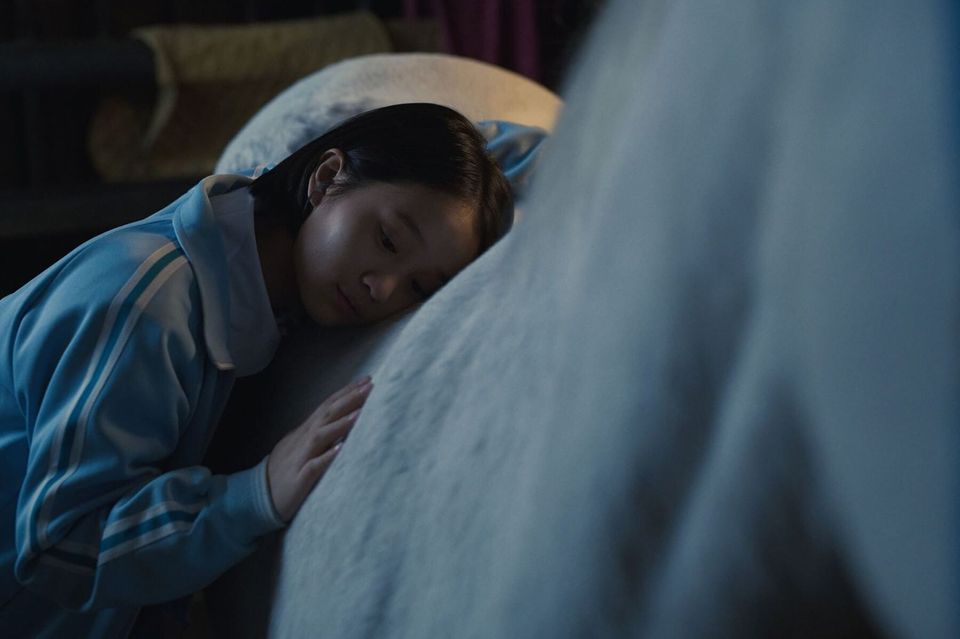
This sense of equine understanding recalls a scene from the film, American Girl, a 2021 movie about a Taiwanese American girl whose family suddenly moves from Los Angeles to Taiwan. Language and culture alienate her, as does a strained relationship with her mother, who is sick with cancer. The young girl yearns to go to a horse camp with her best friend back in California, where she imagines everything will be set right again. On the internet, she finds a horse stable on the outskirts of Taipei and steals away on her own in the night in search of this stable. When she arrives at the horse stall, it is dark and quiet, until you hear the large breath and sigh of a horse. The young girl sees the horse – a large, white animal in the dark, almost like an apparition – and approaches her carefully, imploringly. The girl and the horse lock eyes – and something melts in the atmosphere. She leans against the solid body of the horse and it is as if the horse absorbs all of her fear, all of her loneliness.
I now think – no, I know – that girls who go through a horse phase are onto something.
*
Tomorrow is the first day of the Year of the Fire Horse. In general, Chinese zodiac signs are gender neutral, but I would like to imagine that this year’s horse carries a strong female energy.
Consider this: the character for “mother” – 媽 – is made up of the radical for female, 女, and the character for horse, 馬.