An invitation to engage

Poetry was never a big part of my reading upbringing. For Chinese class, we had to memorize classic Tang dynasty poems, which were often four-line, five-character stanzas with an AABC rhyme scheme. They were sing-song-y and easy to memorize, and also easy to parody. There’s a famous one by Li Bai about homesickness encapsulated in the poem by the action of the speaker lowering his head to ponder the frosty reflection of the moonlight cast on the ground. It’s a beautiful, soulful poem, but kids changed the words to say that after the speaker considers the moon, he lowers his head to…eat his bento.
When I was in my MFA program, 25 years ago, there were only three disciplines: poetry, fiction, and nonfiction. And in that hierarchical order. Poets were inscrutable and cool, fiction writers were edgy and marketable; we essayists and memoirists were just one smidge above journalists at the journalism school. There was something mystical about poetry and poets – we all used words as our building blocks, but it wasn’t logic or linearity that governed poetry, it seemed to be something much more intuitive.
It wasn’t until I started teaching writing that I connected to poetry in a meaningful way. Not surprisingly, this was around the same time that I dipped my toes into literary translation. Both require a kind of close reading that is even more immersive and granular than literary analysis of prose. Because poems are so distilled, where every word, every punctuation, and every line break counts, it necessitates an attention to detail that is – in my experience, almost physical, like digging your fingers into the loamy softness of the words and feeling its texture. In this way, then, poetry is not mystical at all, but earthy and grounded in sensorial experience.
Reading poetry asks that you engage with the text. But what does that mean? And what might that look like? Physically, imagine gears in a piece of machinery that click in and lock together. It’s when gears are thus engaged that the machinery can begin to work. Another form of engagement that comes to mind is when people make a commitment to one another. Being engaged is a promise to live a life together, bound by shared values. Engagement requires connection, attention, and action.
April is National Poetry Month in the US. My colleague invited me to join her in NaPoWriMo, which is short for National Poetry Writing Month, where you commit to writing a poem a day for the month of April. Without giving it much thought, I accepted the invitation. Even though I have become a much more studious reader of poetry, the writing I do is still mainly prose. At most, a poem flits into my mind once or twice a year. The process of writing poetry remains mysterious. So I’ve decided to enter into this month of poems by simply engaging with text. And I am inviting you to join me! Don’t think about poetry with a big P; that’s too daunting and can feel inaccessible. I’m going to give you instructions below and an example of the end product and hopefully, you will feel called to engage with text in a new (poetic!) way.
How to “write” cut-up poetry
Materials:
- Any text that you don’t need anymore –newspaper, magazine, a paper you wrote in college, instruction manual, junk mail
- A pen (I like the Mitsubishi Uni-Ball)
- Scissors
- Glue stick
- Paper
Instructions:
1. Read your text with your pen in hand
2. Carefully draw a box around words and phrases that you feel drawn to
3. Begin thinking about how these words might string together to formulate a sentence or a thought
4. Cut out the words you’ve boxed
5. Rearrange the words into new sentences on your piece of paper
6. At this point, you might need to look for small words – articles like “the” or “of” or conjunctions like “and” or “but” – to cut out and incorporate into your sentence
7. Glue your new sentence/poem onto your paper
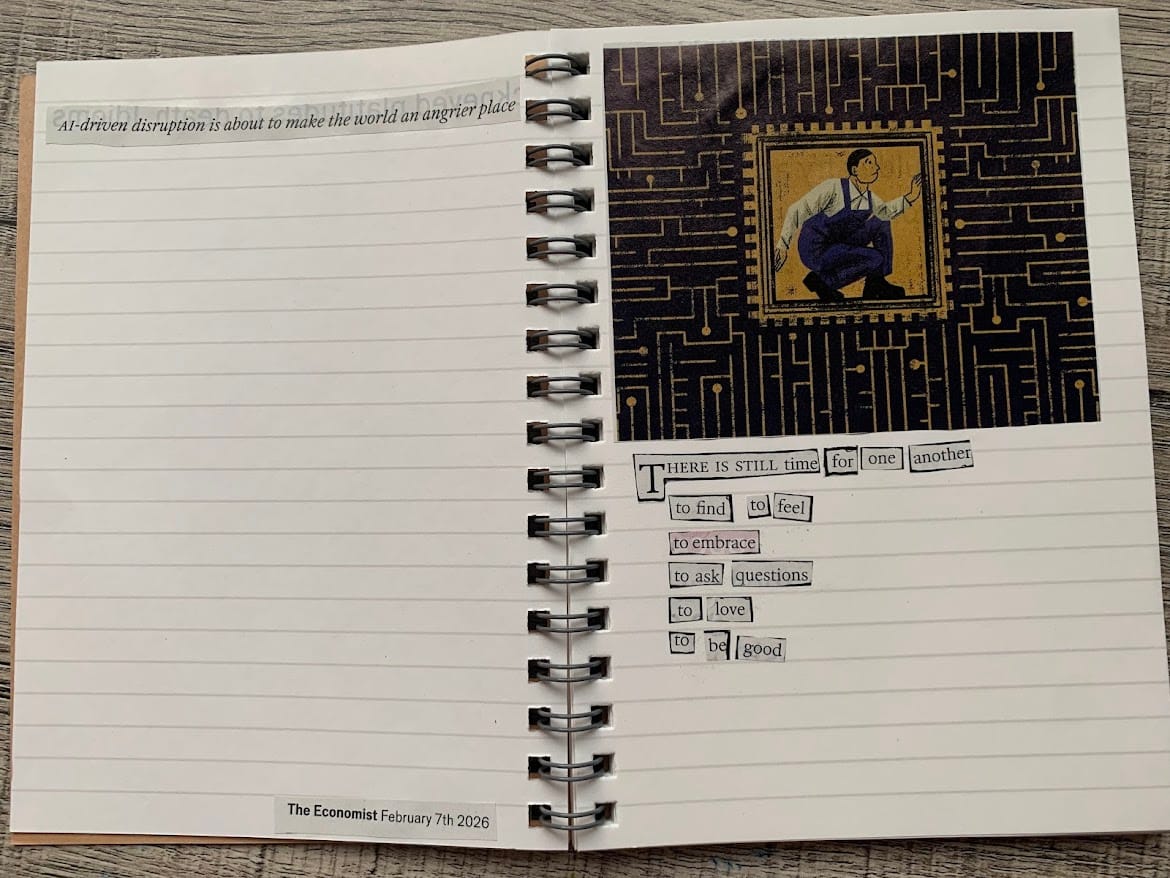
We have a lot of old issues of The Economist around the house. Here, I’ve reframed an article about how AI will make all of us angrier into a poem/call to action:
Now that I think of it, that cheeky parody of the classic Li Bai poem is actually a playful way of engaging with text.
If you decide to give this exercise a go, I'd love to see how you re-envision an old text. It's a lot of fun! Plus, when was the last time you used scissors and glue?